

Nota Volt
Nota Volt is a virtual-analog synth modelled on classic two-oscillator analogs, with a twist: two full signal paths. Each source can go to Filter 1, Filter 2 or both, and each filter has its own amp with pan — so one patch can be two layered sounds.
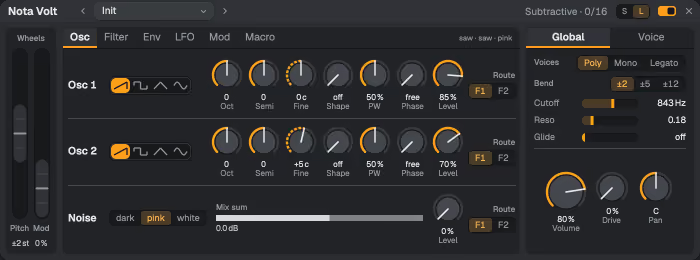
Signal flow:
Osc 1 ┐ ┌─ Filter 1 → Amp 1 (pan, level) ─┐Osc 2 ┼─ route each to F1 / F2 ──┤ ├─→ outNoise ┘ └─ Filter 2 → Amp 2 (pan, level) ─┘ (Filter 1 can also feed Filter 2: "To F2")The wheels on the left (pitch bend, mod wheel) stay on every tab. The rail on the right shows Global or Voice controls.
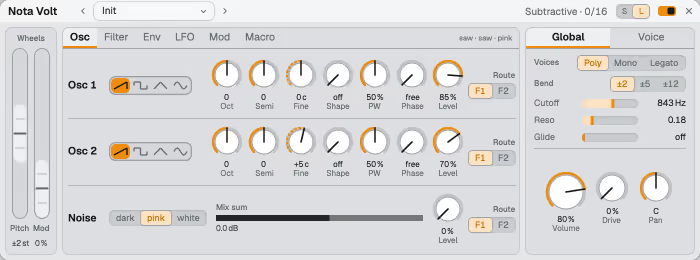
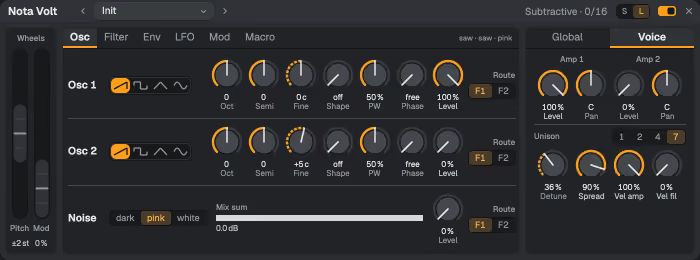
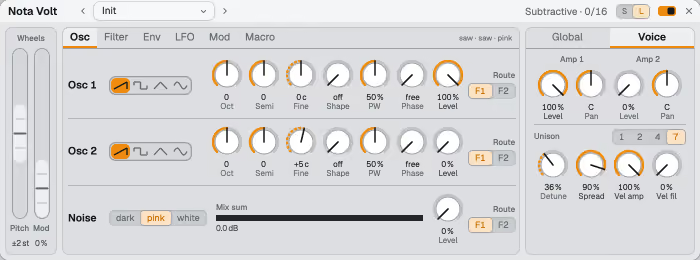
Osc 1, Osc 2 and Noise as a table: wave, Oct, Semi, Fine, Shape, PW, start Phase, Level and Route (which filter it goes to). Noise has a Color.
- Shape morphs the chosen wave toward the next one in the order sine → triangle → saw → square. At 0 (off) you hear the wave as picked; halfway from saw you hear half saw, half square. On the square it does nothing, as there is no wave after it.
- PW (pulse width) narrows or widens the square from 5 % to 95 %. At 50 % it is a plain square; a narrow pulse sounds thinner and more nasal.
Filter
Section titled “Filter”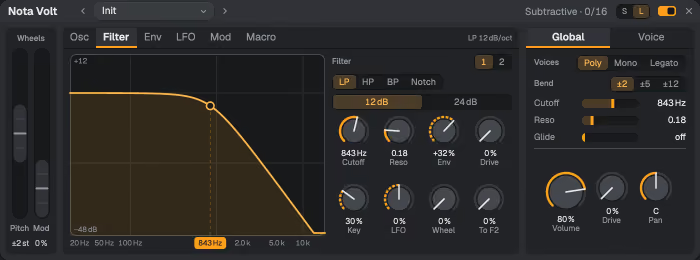
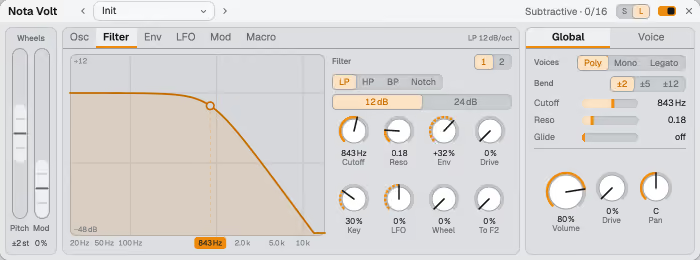
Two state-variable filters — LP, HP, BP or Notch, 12 or 24 dB — each with cutoff, resonance, and Env, Key and LFO amounts. Drag the response pad for cutoff and resonance. On Filter 1, To F2 sends part of it into Filter 2 for serial filtering.
Two knobs act on both filters, so they stay put when you switch between 1 and 2:
- Drive saturates the signal on its way into the filters, from clean up to 12 times the gain. It adds grit and makes the resonance growl, as on an acid bass.
- Wheel (Wheel → LFO) lets the mod wheel open each filter’s LFO onto its cutoff, up to ±2 octaves on top of the filter’s own LFO amount. Raise the wheel to bring in a wobble.
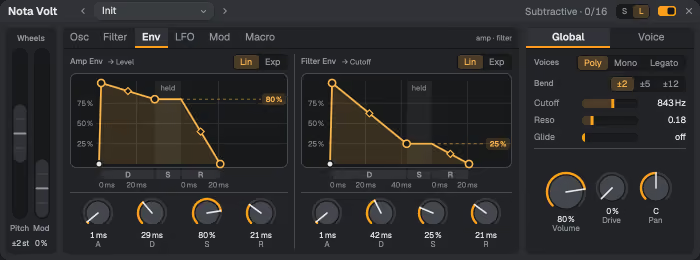
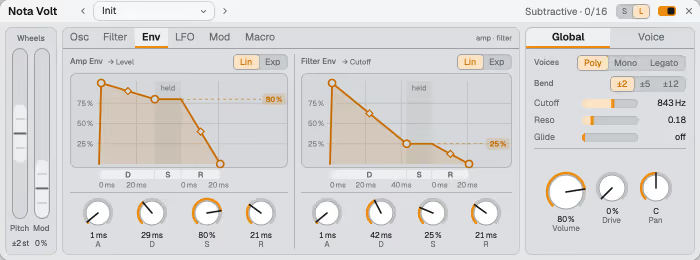
The amp and filter envelopes side by side (A · D · S · R), drawn and draggable.
LFO 1, LFO 2 and Vibrato as a table: shape (sine, triangle, square, S&H), rate, depth, tempo sync and Fade (a per-note fade-in), each showing where it lands. Vibrato can be handed to the mod wheel (By wheel).
A 7 × 6 matrix: Amp Env, Flt Env, LFO 1, LFO 2, Velocity, Key and Mod Wheel against Pitch, Osc 2 Pitch, Cutoff, Reso, Level and Pan. Drag a cell up for +, down for −; ⌥-click it to type the amount (−100…+100 %), double-click to clear it.
Eight macros, each a value, an amount and one of twelve targets — the six matrix destinations, the three source levels, Filter 2’s cutoff and either LFO’s rate.
Global: voice mode, bend range (1–12 semitones), cutoff, resonance, glide, Gain, Drive and Pan.
- Poly plays up to 16 notes. Mono plays one: each new note starts its envelopes again, and when you let go of the top key the note falls back to a key you are still holding. Legato is Mono where a note played over a held one slides in without a new attack.
- Drive saturates the output, from clean up to 8 times the gain, and keeps the level in check as it pushes.
Voice: both output amps (level and pan), the unison section, and Vel Amp / Vel Fil (how much velocity changes the level and the cutoff).
- Unison picks the voices per oscillator. 1 adds one detuned partner to each oscillator, and Detune sets how far (up to 25 cents). 2, 4 and 7 stack that many copies of each oscillator, spread across ±50 cents by Detune, and Spread pans them across the stereo field: the supersaw sound. With 2 to 7 voices and some Spread, each side of the stereo field gets its own filter.
Presets
Section titled “Presets”74 factory presets. Volt’s own 25: pads (Warm Pad, String Machine, Choir Pad, Glass Pad), basses (Fat Bass, Sub Sine, Wobble Bass, Acid Bass, Reese Bass, Growl Bass), leads (Bright Lead, Super Saw, Solo Lead, Hard Lead), keys (Soft Pluck, Drifting Keys, Electric Keys, Bell Tone, Clav Stab) and two-path or motion patches (Split Filter, Dark Drone, Sample & Hold, Noise Sweep, Siren, Serial Filters).
The other 49 are the former Nota Synth and Nota Bass libraries, rebuilt on Volt so they sound the same. Synth’s are filed with Volt’s own (Pads, Bass, Leads, Keys & Plucks, Bells & Mallets, Textures & FX). Bass’s keep their own folders: Sub Bass, Analog Bass, Acid, Growl & Wobble and Electric Bass. Where Volt already had a preset of the same name, the ported one was renamed: for example Synth’s Super Saw is Super Saw 7 and Bass’s Reese Bass is Deep Reese.
- Two sounds in one: send Osc 1 to F1 (low-pass, panned left) and Osc 2 to F2 (band-pass, panned right).
- Classic S&H bleeps: LFO 1 on S&H, routed to cutoff, synced to 1/16.
- Supersaw: saw on both oscillators, Unison 7, Detune around 30 %, Spread up.
- Sub under a bass: Osc 2 on sine, Oct −1, routed to the same filter.
- 303 line: saw or square into a 24 dB low-pass, high resonance, filter envelope up, some Drive, Legato with a little glide.