

Nota Consort
Nota Consort is a semi-modular synth in the spirit of a four-oscillator paraphonic Moog. It plays as a big mono synth, as two or four voices sharing one filter, or as a true polysynth — and a patch bay lets you re-wire it with cables.
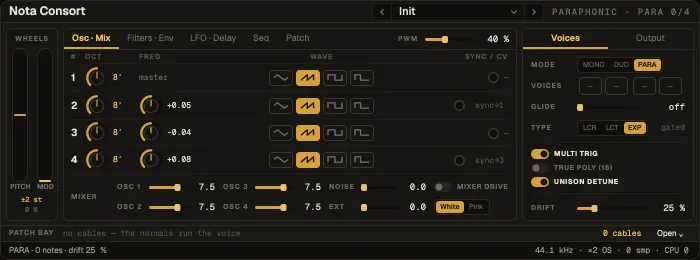
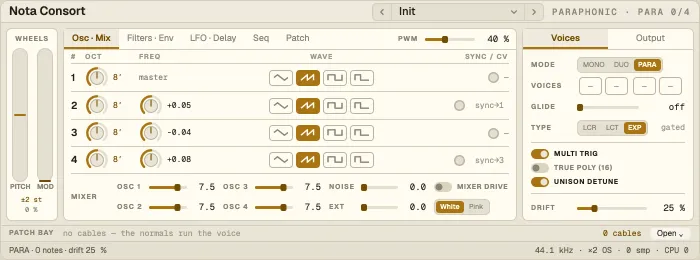
Signal flow: VCO 1–4 (2 syncs to 1, 4 to 3) + noise + EXT → mixer (with drive) → two ladder filters → VCA → analog delay. Env 1 → cutoff, Env 2 → VCA, LFO → pitch, cutoff, PWM.
Voices
Section titled “Voices”| Mode | How it plays |
|---|---|
| MONO | All four oscillators on one note |
| DUO | Oscillators 1 + 2 and 3 + 4 each take a note |
| PARA | Every oscillator takes its own note — paraphony: they share one filter, VCA and envelopes |
| True poly (16) | A switch: 16 complete voices, each with four oscillators, two filters and two envelopes |
Multi trig retriggers the shared envelopes on every note; Unison detune doubles held notes on idle oscillators, detuned. All three switches sit on the Voices tab of the right panel. Glide per oscillator: LCR (constant rate), LCT (constant time) or EXP, optionally only when legato.
| Tab | What’s there |
|---|---|
| Osc · Mix | The four oscillators — octave, tuning, wave, pulse width, sync — and the mixer with noise and drive |
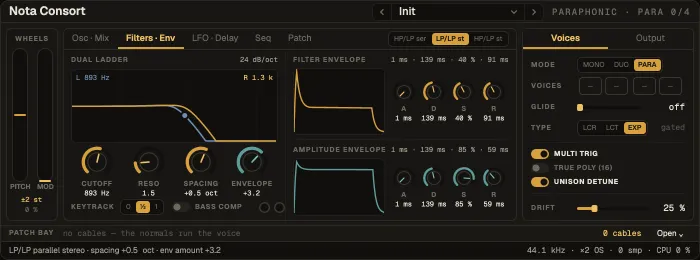
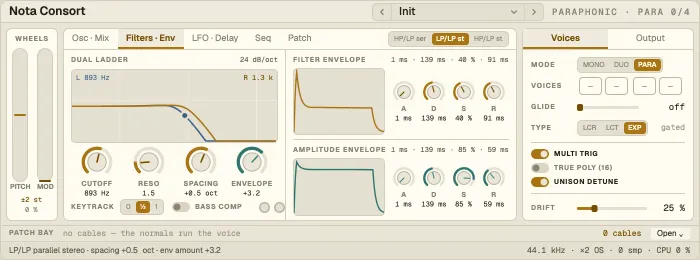
| Filters · Env | The dual ladder: HP/LP ser (series), LP/LP st or HP/LP st (parallel stereo), cutoff, resonance, spacing, keyboard tracking (0, ½, 1); the filter and amplitude envelopes |
| LFO · Delay | The LFO (six shapes; to all oscillators or 2 + 4) and the analog delay — a bucket-brigade model (BBD: longer is darker, with compander breathing and hiss), Ping or Stereo, or a clean Digital line |
| Seq | A 16-step sequencer and arpeggiator — see below |
| Patch | The patch bay — see below |
Sequencer and arpeggiator
Section titled “Sequencer and arpeggiator”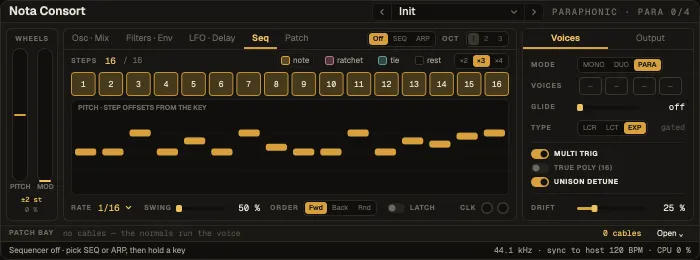
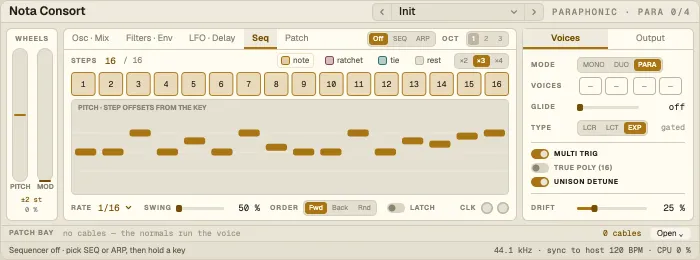
Off, SEQ or ARP. Sixteen steps, each a note, a ratchet (×2, ×3, ×4), a tie or a rest, ±24 semitones; rates 1/4 to 1/32 with swing; Fwd, Back or Rnd order; latch. In SEQ the keyboard transposes the sequence; in ARP it walks the held chord over 1, 2 or 3 octaves, and the step types still shape the rhythm. It locks to the grid while the transport runs.
Patch bay
Section titled “Patch bay”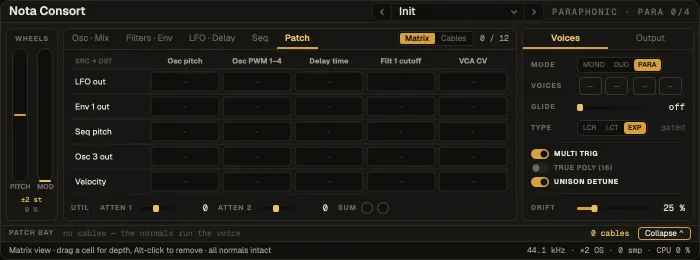
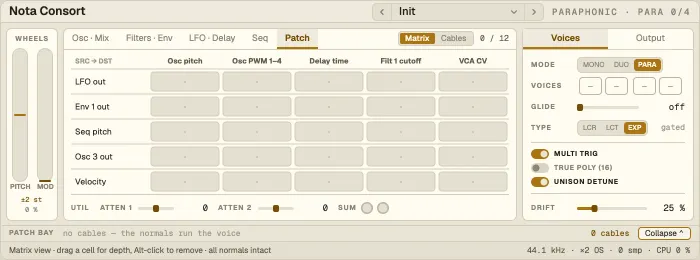
Twelve cables, each a source, a destination and a ± depth. Sources include the oscillators, the filter, noise, the LFO, both envelopes, keyboard pitch, gate and velocity, aftertouch, the mod wheel, the sequencer’s pitch, gate and clock, two attenuators and a summing node. Destinations include pitch, PWM, cutoff, resonance, the VCA, the delay and the LFO rate — plus normalled inputs (the envelope gates, filter in, VCA in, EXT in) where a cable breaks the default connection. Feedback loops are allowed.
The Patch tab shows the cables as a source × destination matrix and as a jack strip; the PATCH BAY row under the card lists the active cables and opens a full-card overlay with every jack. Drag from jack to jack to patch; ⌥-click a jack to pull its cables.
Presets
Section titled “Presets”28 factory presets: pads and chords (Stereo Consort, Para Strings, Spread Voicing, Duo Sync Pad, Poly Pad, Glass Chords, Poly Keys), basses (Ladder Bass, Deep Sub, Feedback Growl, FM Growl), leads (Duo Fifths, Unison Lead, Sync Lead, Ladder Whistle, Wheel Wah), sequences (Ratchet Run, Acid Run, Arp Cascade, Random Arp, Latch Sequence, Trance Gate) and patches (Patched Drift, Ring Bells, Wind Noise, Touch Stereo, Delay Warp).