

Nota Operator
Nota Operator is an FM synth: four oscillators — operators A, B, C, D — bend each other’s phase to make harmonics a filter can’t. Electric pianos, bells, glassy pads, slap and FM basses.
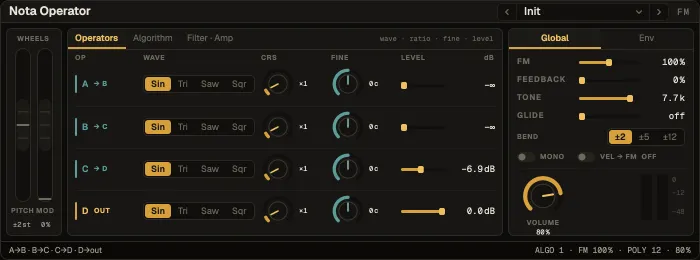
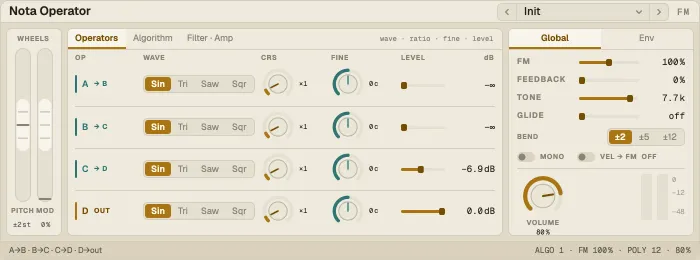
Signal flow: operators A–D, wired by the algorithm (modulators bend their targets; A can feed back into itself) → carriers → filter → volume.
In the card, brass marks a carrier — what reaches the output; teal a modulator. The wheels (pitch bend, mod wheel on the FM depth) stay on every tab.
Operators
Section titled “Operators”Each operator, as a row: its role in words, Wave (Sin, Tri, Saw, Sqr), Crs (frequency ratio: 0.5, 1, 2 … 14 or 16), Fine (detune), Level with its dB.
Algorithm
Section titled “Algorithm”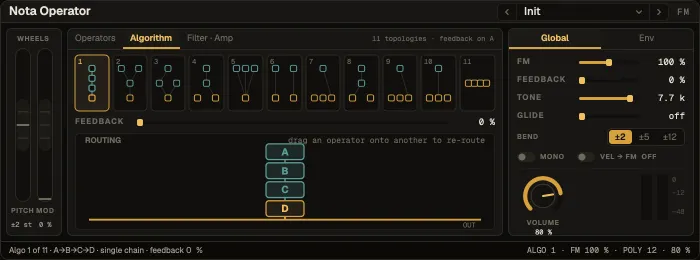
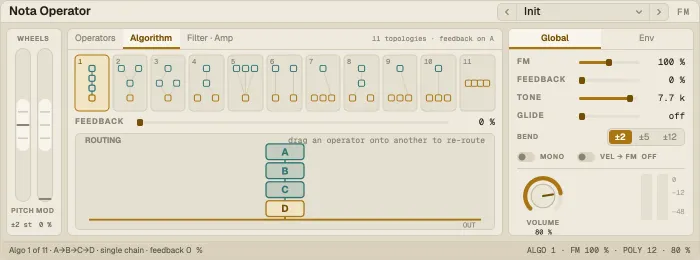
Eleven topologies as sketches — chains, stacks, parallel (additive) — and a routing diagram: drag one operator onto another to re-route. Feedback feeds operator A back into itself for grit and noise.
Filter · Amp
Section titled “Filter · Amp”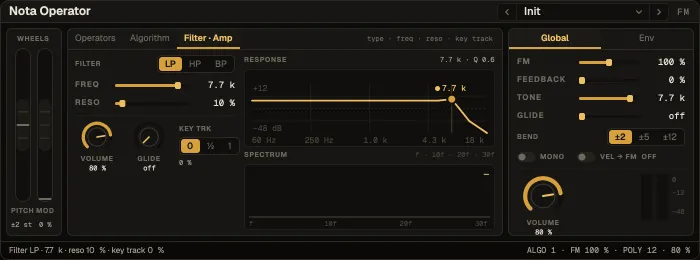
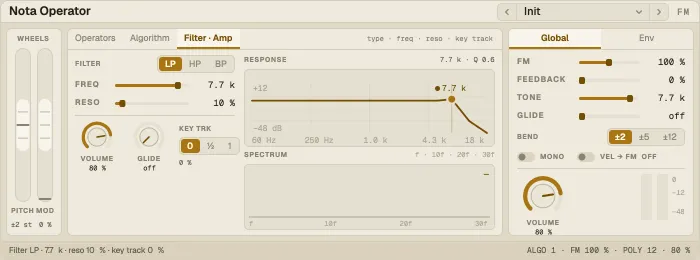
A subtractive filter after the FM: LP, HP or BP, Freq, Reso, Key Trk, and the output volume — beside a live harmonic spectrum.
Global: FM depth, Feedback, Tone, Glide, bend range, voice mode (Poly 12 / Mono), Volume, and Vel → FM (play harder for a brighter note). Env: the selected operator’s ADSR, drawn and draggable, with Key → Lvl and Vel → Lvl tracking.
Presets
Section titled “Presets”25 factory presets: pads (Glass Pad, Air Pad, Choir Pad, Warm Strings), basses (FM Bass, Slap Bass, Sub Sine, Growl Bass), leads (Bright Lead, Reed Lead, Metal Lead, Whistle), keys (E-Piano, Tine Keys, Wurly, Clav, Harpsichord, Drawbar Organ), bells and mallets (FM Bell, Tubular Bell, Music Box, Marimba, Kalimba, Log Drum) and Brass Section.
- Classic e-piano: a 1:1 carrier with a modulator at a ratio of 14 and a short decay on the modulator — that’s the “tine”.
- Brighter with velocity: raise Vel → FM so soft notes stay mellow.