

Nota Keys
Nota Keys is an electric piano built from its physics: a hammer strikes a tine (with its tone bar), a reed or a string, and the vibration passes a pickup that colours it — the harder you play, the more it growls. Four models in one instrument: Tine and Suitcase (the classic tine piano, stage and suitcase), Reed (the reed piano) and Clav (a struck, damped string with two pickups).
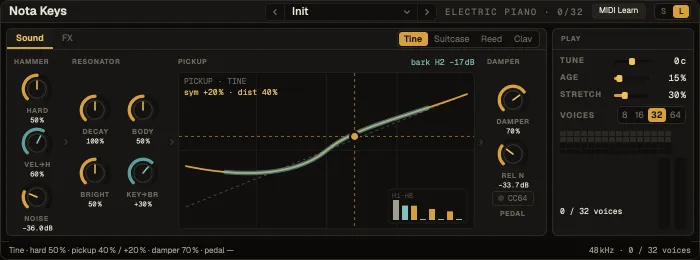
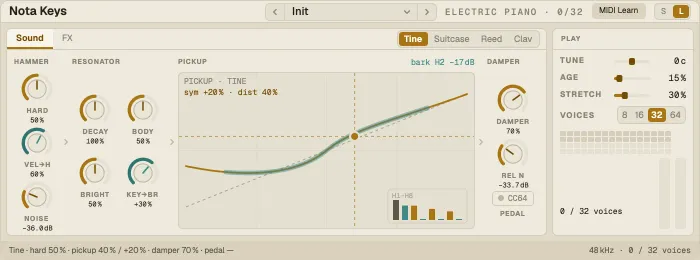
Signal flow: hammer → tine / reed / string → pickup → preamp → tremolo → phaser → chorus → cabinet → output. Up to 64 voices.
The card has two sizes — L with the Sound and FX tabs, and S with the model, the pickup and four knobs. Switch them with S / L in the header.
The model chips (Tine, Suitcase, Reed, Clav) sit in the tab strip. Picking a model also sets the pickup and the cabinet it is usually heard with.
| Section | Control | What it does |
|---|---|---|
| Hammer | Hard | Hammer hardness: soft is dark and round, hard is bright and percussive |
| Vel→H | How much harder the hammer gets when you play harder | |
| Noise | The thump of the hammer, off or −60 to −12 dB | |
| Resonator | Decay | How long a note rings, 25 % to 400 % of the model’s natural time |
| Body | The weight of the fundamental and the tone bar | |
| Bright | The bell-like upper partials | |
| Key→Br | Brighter up the keyboard (or darker, below the centre) | |
| Pickup | the graph | Drag the point: ↔ Symmetry, ↕ Distance (see below) |
| Damper | Damper | How fast a released key stops: low rings on, high stops in ~25 ms |
| Rel N | The thump of the damper felt on release | |
| CC64 / Pedal | The sustain pedal — click it, automate it, or press your keyboard’s pedal |
The pickup curve
Section titled “The pickup curve”The graph is the transfer curve the sound actually goes through, not a picture of it. The teal band is how far a full-velocity note swings. Distance (up/down) moves the pickup closer — the curve bends more and loud notes saturate; Symmetry (left/right) offsets the tine against the pickup, adding even harmonics: that’s the bark, read out above the graph, and the H1–H8 bars show what the curve does to a sine. Quiet notes stay in the straight middle of the curve and sound clean; hard ones reach its knees.
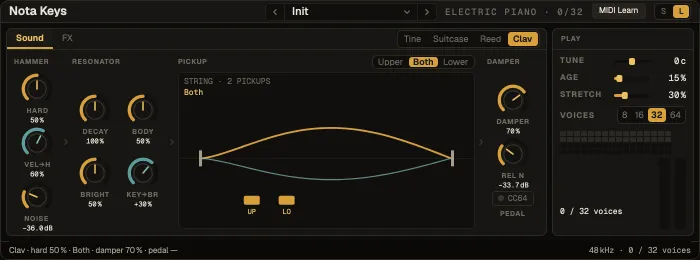
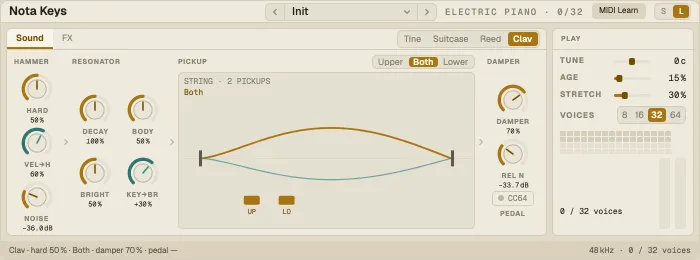
With Clav the graph shows the string and its two pickups instead: Upper is thin and bright, Lower fuller, Both sums them.
The rail on the right: Tune (±50 cents), Age (each key drifts a little in pitch, decay and level — the same every time), Stretch (an octave stretch like a tuned piano) and Voices (8, 16, 32 or 64). The grid shows the voices: bright for keys held down, dim for notes ringing out or held by the pedal. Re-striking a ringing key hits the same tine again.
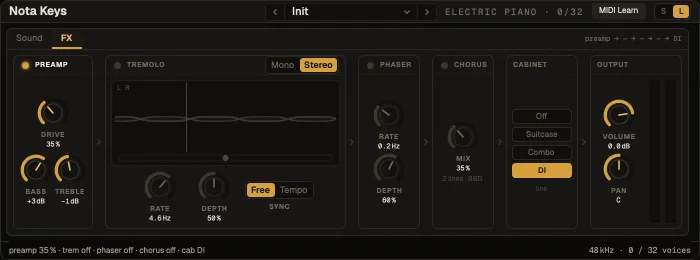
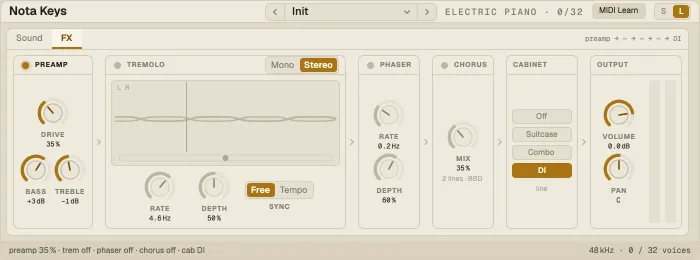
Each effect has its power dot; the chain in words sits on the right of the tab strip.
| Effect | Controls |
|---|---|
| Preamp | Drive into a soft clipper, Bass and Treble shelves (±12 dB) |
| Tremolo | Mono (level) or Stereo (auto-pan, the suitcase sound); Rate — free (0.5–15 Hz) or Tempo (1/1 to 1/32); Depth |
| Phaser | Rate (0.05–5 Hz) and Depth |
| Chorus | Mix |
| Cabinet | Off, Suitcase (2×12″ wood), Combo (the reed piano’s speaker) or DI (line) |
| Output | Volume and Pan |
A tempo-synced tremolo locks to the bar while the transport runs, so a freeze or a bounce sounds exactly like playback.
S size
Section titled “S size”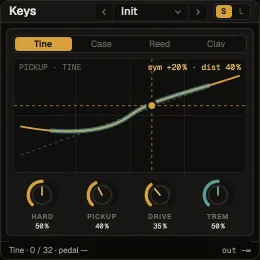
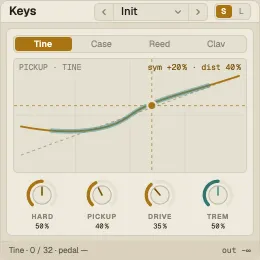
The model, the pickup graph, and Hard, Pickup (distance), Drive and Trem (depth). The preset picker is the same as in L.
Playing it
Section titled “Playing it”- Velocity is the instrument. The bark, the brightness and the hammer all follow how hard you play — record from a keyboard or shape velocities in the piano roll.
- Sustain pedal: your keyboard’s pedal (CC64) holds notes; the Pedal button and its automation lane do the same in a clip. Lifting it drops the dampers on everything it held.
- MPE: bend retunes a note, pressure drives the tine harder into the pickup, slide shifts the pickup’s symmetry — see MIDI controllers.
Presets
Section titled “Presets”40 factory presets in six folders: Basics (Mk I Stage, Suitcase Init, 200A Classic, D6 Funk), Tine (from Ballad Tine and Mellow Mk II to Bark Lead, Phase Ninety and Tine Bells), Suitcase (Suitcase Stereo, Slow Pan, Fast Pan, Synced Eighths, Dream Case…), Reed (Reed Bark, School Reed, Reed Tremolo, Overdriven Reed…), Clav (D6 Bright, Clav Lower, Funk Drive, Muted Clav…) and Character (Lo-Fi Keys, Detuned Tape, Toy Box, Ambient Tine).
- Growl on demand: lower Distance and push Symmetry off-centre, then play harder — soft notes stay sweet, loud ones bark.
- The suitcase sound: Suitcase model, Stereo tremolo around 4–5 Hz, Suitcase cabinet.
- Funky clav: Clav, Upper pickup, Damper high, a touch of Phaser.